
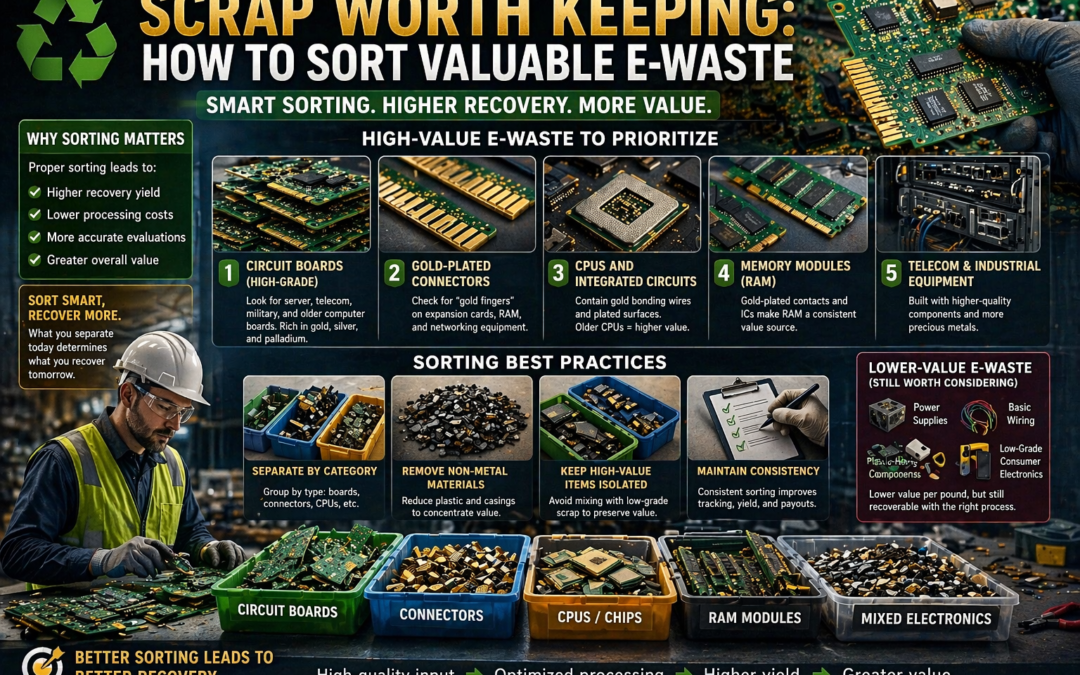
Not all electronic scrap is created equal.
Some items contain meaningful amounts of precious metals like gold, silver, and palladium — while others offer very little recovery value. The difference often comes down to how well materials are sorted before processing.
For businesses handling e-waste, proper sorting can directly impact recovery yield, efficiency, and overall profitability.
Here’s how to identify what’s worth keeping — and why it matters.
Why Sorting E-Waste Is So Important
When valuable and low-value materials are mixed together, it creates problems:
- Lower recovery efficiency
- Increased processing costs
- Reduced overall yield
- Less accurate material evaluation
Sorting allows high-value materials to be processed more effectively, helping maximize the amount of precious metal recovered.
Better sorting = better results.
High-Value E-Waste to Prioritize
Certain types of electronic scrap consistently contain higher concentrations of precious metals.
1. Circuit Boards (Especially High-Grade)
Not all boards are equal.
Higher-value boards include:
- Server boards
- Telecom boards
- Military or industrial boards
- Older-generation computer boards
These often contain:
- Gold-plated connectors
- Integrated circuits with bonding wires
- Dense component layouts
Lower-grade boards (like simple power boards) typically contain less recoverable value.
2. Gold-Plated Connectors
Often called “gold fingers,” these are one of the most recognizable high-value items.
Look for:
- Edge connectors from computers
- Expansion cards (RAM, PCI, GPUs)
- Networking equipment
These components often contain thin but concentrated layers of gold.
3. CPUs and Integrated Circuits
Processors and chips can contain valuable materials, including:
- Gold bonding wires
- Gold-plated surfaces
- Other recoverable metals
Older CPUs, especially ceramic ones, tend to have higher value compared to newer designs.
4. Memory Modules (RAM)
RAM sticks often contain:
- Gold-plated contact edges
- Multiple integrated circuits
They are typically easy to identify and separate, making them a consistent source of recoverable material.
5. Telecom and Industrial Equipment
Equipment from telecom systems, servers, and industrial machinery often contains:
- Higher-quality components
- More durable materials
- Increased use of precious metals
These items are often overlooked but can provide strong recovery value.
Lower-Value E-Waste (But Still Worth Considering)
Not everything needs to be discarded — but some items typically contain lower concentrations of precious metals:
- Power supplies
- Basic wiring
- Plastic-heavy components
- Low-grade consumer electronics
These materials may still be recoverable, but they are usually less valuable per pound compared to high-grade items.
Key Sorting Best Practices
Separate by Category
Group materials into categories such as:
- Circuit boards
- Connectors
- CPUs/chips
- Mixed electronics
This improves evaluation accuracy and processing efficiency.
Remove Obvious Non-Metal Materials
Reducing excess materials helps concentrate value:
- Plastics
- Casings
- Non-electronic components
This allows recovery systems to focus on metal-bearing material.
Keep High-Value Items Isolated
Avoid mixing high-grade materials with low-grade scrap.
Keeping them separate helps:
- Preserve value
- Improve recovery yield
- Ensure more accurate payouts
Maintain Consistency
Consistent sorting practices over time provide:
- Better tracking of material performance
- More predictable recovery outcomes
- Improved operational efficiency
How Sorting Impacts Yield
Because precious metals in e-waste are often spread across small components, sorting directly affects how much is recovered.
When materials are properly sorted:
- Recovery processes can be optimized
- Fine particles are more easily captured
- Losses are reduced
When materials are poorly sorted:
- Valuable components may be diluted
- Recovery becomes less efficient
- Yield decreases
In e-waste recovery, sorting is one of the first and most important steps in protecting value.
How Material Recovery Technologies Supports E-Waste Sorting
At Material Recovery Technologies (MRT), sorting is treated as a critical part of the recovery process.
MRT focuses on:
- Accurate material evaluation
- Clear categorization of incoming materials
- Process optimization based on material type
- Transparent recovery tracking
This ensures that each type of material is handled in a way that maximizes recovery potential.
Final Takeaway
Not all scrap is equal — but with the right approach, you can identify what’s worth keeping.
By focusing on high-value components like circuit boards, connectors, and CPUs, and by maintaining consistent sorting practices, businesses can:
- Increase recovery yield
- Improve efficiency
- Capture more value from e-waste
Because in precious metal recovery, what you separate upfront determines what you recover in the end.
Recent Comments