
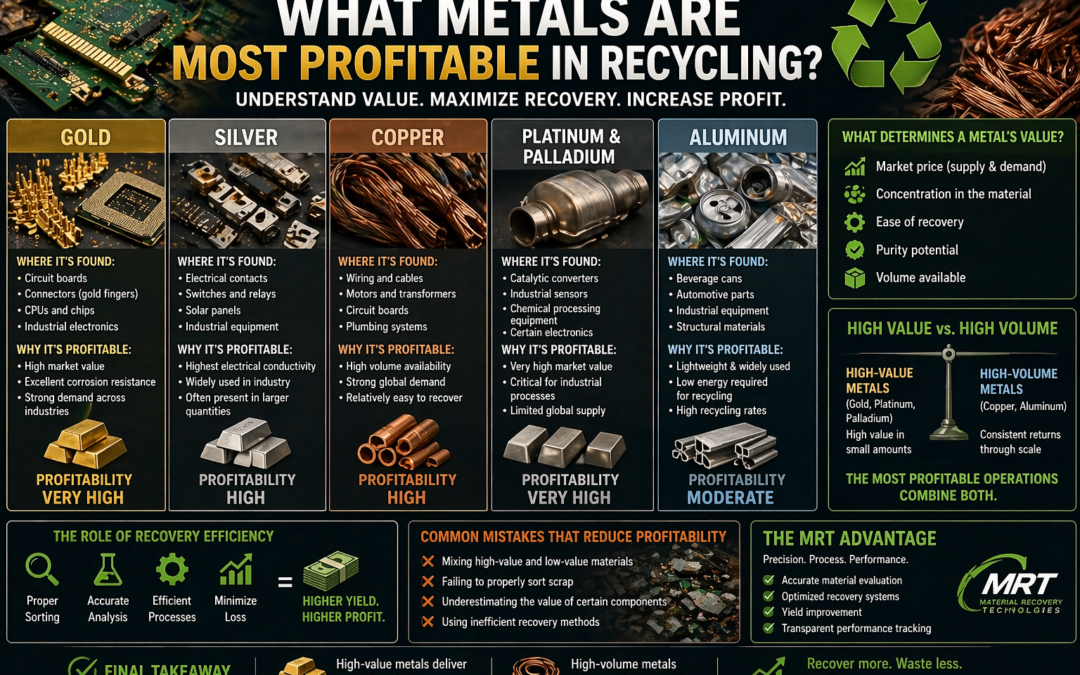
Not all metals are created equal — especially when it comes to recycling.
Some materials are abundant but low in value, while others are rare, highly sought after, and extremely profitable when recovered correctly.
For businesses handling scrap, electronics, or industrial materials, understanding which metals drive the most value can make a major difference in profitability.
Let’s break down the metals that matter most.
What Determines a Metal’s Value?
Before looking at specific metals, it’s important to understand what makes a metal profitable in recycling.
Key factors include:
- Market price (supply and demand)
- Concentration in the material
- Ease of recovery
- Purity potential
- Volume available
The most profitable metals typically combine high market value with recoverability.
1. Gold
Gold is one of the most valuable metals in recycling — especially in electronics.
Where It’s Found:
- Circuit boards
- Connectors (“gold fingers”)
- CPUs and chips
- Industrial electronics
Why It’s Profitable:
- High market value per ounce
- Excellent corrosion resistance
- Strong demand across industries
Even though gold is often present in small amounts, it adds up quickly across large volumes of material.
2. Silver
Silver is often overlooked, but it plays a major role in recycling value.
Where It’s Found:
- Electrical contacts
- Switches and relays
- Solar panels
- Industrial equipment
Why It’s Profitable:
- Highest electrical conductivity of any metal
- Widely used in industrial applications
- Often present in larger quantities than gold
Silver can provide strong returns, especially in high-volume recycling operations.
3. Copper
Copper is one of the most important and widely recycled metals.
Where It’s Found:
- Wiring and cables
- Motors and transformers
- Circuit boards
- Plumbing systems
Why It’s Profitable:
- High volume availability
- Strong global demand
- Relatively easy to recover
While copper is less valuable per pound than precious metals, its volume makes it a major profit driver.
4. Platinum & Palladium
These metals are part of the platinum group and are extremely valuable in specialized applications.
Where They’re Found:
- Catalytic converters
- Industrial sensors
- Chemical processing equipment
- Certain electronics
Why They’re Profitable:
- Very high market value
- Critical for industrial processes
- Limited global supply
These metals often deliver high value, but recovery requires specialized processes.
5. Aluminum
Aluminum is one of the most commonly recycled metals.
Where It’s Found:
- Beverage cans
- Automotive parts
- Industrial equipment
- Structural materials
Why It’s Profitable:
- Lightweight and widely used
- Low energy required for recycling
- High recycling rates
Like copper, aluminum profits come from volume and efficiency.
High Value vs. High Volume
One of the most important concepts in recycling is understanding the difference between:
- High-value metals (gold, platinum, palladium)
- High-volume metals (copper, aluminum)
The most profitable recycling operations often combine both:
- Recovering small amounts of high-value metals
- Processing large amounts of lower-value metals efficiently
Balancing these two categories is key to maximizing total returns.
The Role of Recovery Efficiency
No matter how valuable a metal is, profitability depends on how much is actually recovered.
Key factors include:
- Proper material sorting
- Accurate material analysis
- Efficient recovery processes
- Minimizing material loss
Even small improvements in recovery yield can significantly increase overall profitability.
Common Mistakes That Reduce Profitability
Businesses often lose value by:
- Mixing high-value and low-value materials
- Failing to properly sort scrap
- Underestimating the value of certain components
- Using inefficient recovery methods
Understanding material composition is just as important as understanding market prices.
How Material Recovery Technologies Maximizes Value
At Material Recovery Technologies (MRT), profitability is driven by precision and process control.
MRT focuses on:
- Accurate material evaluation
- Optimized recovery systems
- Yield improvement
- Transparent performance tracking
The goal is to ensure that every recoverable metal — especially high-value precious metals — is captured efficiently.
Final Takeaway
The most profitable metals in recycling depend on both value and volume.
- Gold, platinum, and palladium deliver high value in small amounts
- Copper and aluminum generate consistent returns through scale
- Silver bridges the gap with both value and volume
Understanding where these metals exist — and how to recover them efficiently — is the key to maximizing profitability.
Because in recycling, what you recover matters — but how much you recover matters even more.
Recent Comments