
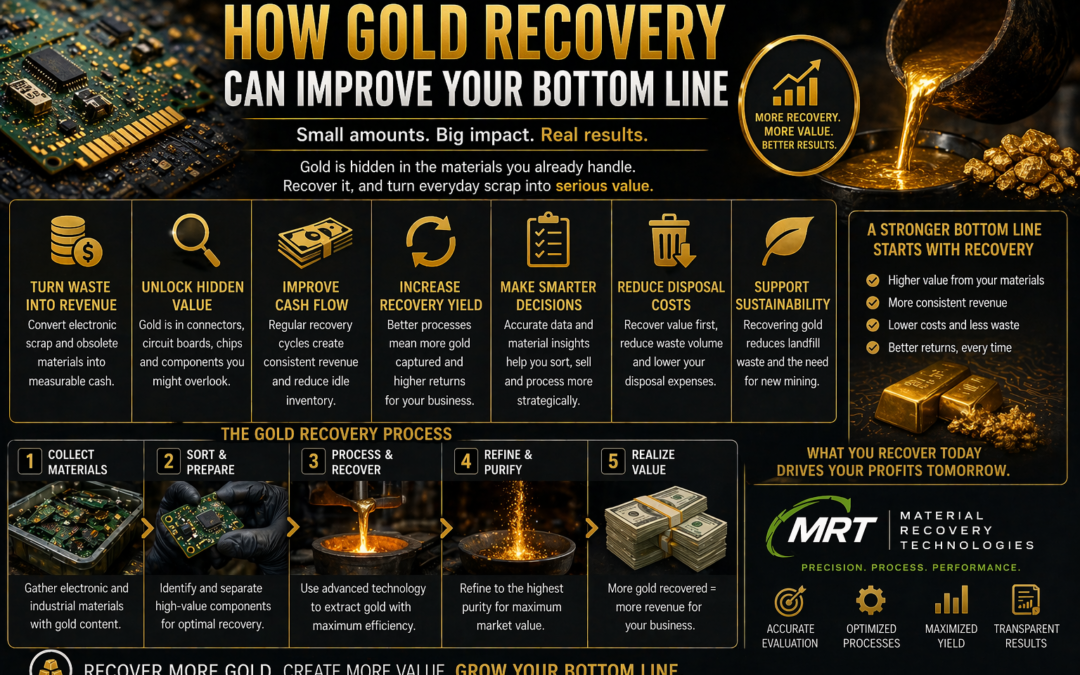
Gold isn’t just sitting in vaults — it’s embedded in everyday business materials.
From electronic scrap to industrial components, many companies handle materials that contain small amounts of gold. When recovered efficiently, those small amounts can turn into meaningful revenue.
If you’re not actively recovering gold, you could be leaving value on the table.
Let’s break down how gold recovery directly improves your bottom line.
Turning Waste Into Revenue
Many businesses treat electronic scrap and outdated equipment as waste.
But in reality, these materials often contain:
- Gold-plated connectors
- Circuit boards
- CPUs and chips
- Industrial components
Instead of discarding or undervaluing these materials, recovery allows you to:
Convert unused or obsolete inventory into cash.
Even small quantities of gold add up quickly when processed at scale.
Unlocking Hidden Value in Your Operations
Gold is rarely obvious in modern materials.
It’s typically found in:
- Thin plating layers
- Microscopic bonding wires
- Small but critical components
Because it’s not visible, it’s easy to overlook.
A structured recovery process helps uncover that hidden value and ensures it’s not lost during disposal or resale.
Improving Cash Flow
One of the biggest financial benefits of gold recovery is cash flow improvement.
Instead of holding onto scrap materials, businesses can:
- Process materials regularly
- Generate more consistent revenue
- Reduce idle inventory
More frequent recovery cycles turn stored material into active income.
Reducing Material Loss
Without proper recovery systems, valuable metals can be lost during handling or disposal.
Inefficient processes may result in:
- Incomplete extraction
- Loss of fine gold particles
- Missed recovery opportunities
Optimized recovery processes focus on maximizing yield — ensuring that as much gold as possible is captured.
Increasing Recovery Yield = Increasing Profit
Yield plays a major role in profitability.
- Higher yield = more gold recovered
- More gold recovered = higher returns
Even small improvements in recovery efficiency can lead to significant financial gains over time.
For example:
A few percentage points of additional recovery across large volumes can translate into thousands — or more — in added value.
Supporting Smarter Material Decisions
When you understand how much gold is in your materials, you can make better decisions about:
- What to keep and process
- What to sell as scrap
- How to sort materials
- When to process them
Gold recovery provides data and insight that support smarter operational strategies.
Reducing Disposal Costs
Disposing of electronic or industrial waste can be expensive.
By recovering valuable metals first, businesses can:
- Reduce waste volume
- Lower disposal costs
- Offset operational expenses
Recovery transforms disposal from a cost center into a revenue opportunity.
Strengthening Sustainability Efforts
Gold recovery isn’t just good for your finances — it also supports sustainability.
By recovering and reusing metals:
- Less material goes to landfills
- Demand for new mining is reduced
- Environmental impact is minimized
Many companies are now aligning recovery efforts with their sustainability goals.
How Material Recovery Technologies Maximizes Your Return
At Material Recovery Technologies (MRT), gold recovery is approached with precision and transparency.
MRT focuses on:
- Accurate material evaluation
- Optimized recovery processes
- Yield maximization
- Clear performance tracking
The goal is simple:
Recover the most gold possible from your materials — and make sure you see the value.
Final Takeaway
Gold recovery is not just a technical process — it’s a financial strategy.
By identifying, processing, and recovering gold from your materials, you can:
- Unlock hidden value
- Improve cash flow
- Increase profitability
- Reduce waste and costs
For businesses handling electronic or industrial materials, gold recovery offers a clear opportunity to strengthen the bottom line.
Because in today’s market, what you recover can be just as important as what you produce.
Recent Comments