
When people think of precious metals like gold, silver, or platinum, they often think of jewelry or coins.
But some of the most important uses of these metals are hidden inside industrial machinery — powering systems, improving performance, and ensuring long-term reliability.
From manufacturing plants to energy systems, precious metals play a critical role in keeping modern industry running.
Let’s take a closer look at where they’re used — and why they matter.
Why Precious Metals Are Used in Industry
Precious metals are not just valuable — they have unique physical and chemical properties that make them essential in demanding environments.
These include:
- Excellent electrical conductivity
- Resistance to corrosion and oxidation
- High temperature stability
- Strong catalytic properties
Because of these advantages, they are used in components where failure is not an option.
Common Precious Metals Found in Machinery
Several precious metals are commonly used across industrial systems:
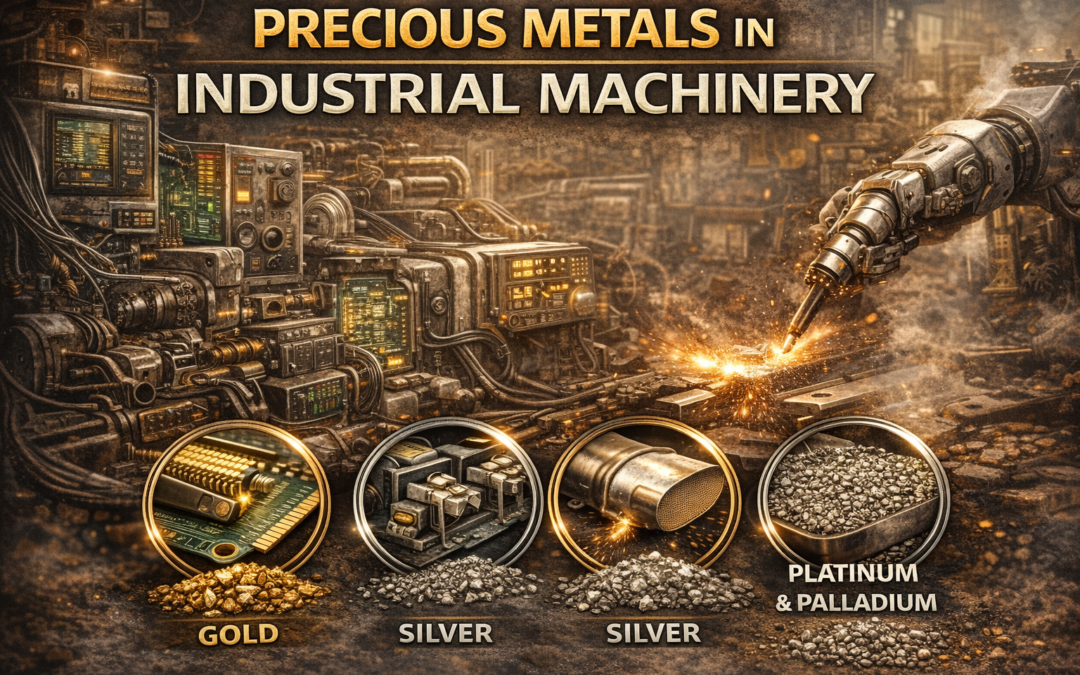
Gold
Used for:
- Electrical contacts
- High-reliability connectors
- Sensitive electronic components
Gold ensures consistent performance, especially in environments where corrosion could cause failure.
Silver
Used for:
- Electrical conductors
- Switches and relays
- Power transmission components
Silver has the highest electrical conductivity of any metal, making it ideal for high-performance systems.
Platinum & Palladium
Used for:
- Catalytic converters
- Chemical processing equipment
- Sensors and monitoring systems
These metals are critical in environments involving chemical reactions and extreme temperatures.
Where These Metals Exist in Machinery
Precious metals are typically not found in large, visible amounts.
Instead, they are integrated into specific components such as:
- Control panels and circuit systems
- Industrial sensors and probes
- Electrical contacts and relays
- Coated surfaces and plating layers
- High-performance connectors
Like circuit boards, these metals are often thinly distributed but highly valuable when aggregated.
Why Recovery Matters
Over time, industrial machinery reaches the end of its lifecycle.
When that happens, valuable materials inside the equipment can either:
- Be discarded as waste
- Or recovered and reused
Recovering precious metals from industrial machinery provides several benefits:
Financial Value
Even small amounts of gold, silver, or platinum can add up across large volumes of equipment.
Resource Efficiency
Recovered metals can be reused, reducing the need for new mining.
Environmental Impact
Proper recovery helps reduce industrial waste and supports sustainable practices.
Challenges in Recovering Precious Metals
Industrial machinery is complex.
Recovering metals from it requires overcoming several challenges:
- Mixed material compositions
- Metal coatings and alloys
- Embedded components
- Varying concentrations of precious metals
Unlike simple scrap, machinery often requires careful processing and precise recovery methods to extract value efficiently.
The Role of Process Control and Yield
Because precious metals in machinery are often dispersed, recovery depends heavily on process efficiency.
Key factors include:
- Accurate material evaluation
- Proper disassembly and preparation
- Controlled recovery methods
- Effective capture of fine particles
In these systems, yield determines how much of the available metal is actually recovered.
Even small inefficiencies can lead to lost value.
How Material Recovery Technologies Approaches Industrial Recovery
At Material Recovery Technologies (MRT), industrial machinery recovery is treated as a precision-driven process.
MRT focuses on:
- Detailed material analysis
- Controlled recovery systems
- Yield optimization
- Transparent performance tracking
The goal is to recover valuable metals from complex machinery with consistency and accuracy.
Final Takeaway
Precious metals are essential to modern industrial machinery — even if they’re not visible.
They enable performance, reliability, and efficiency across critical systems.
When that machinery reaches the end of its life, those same metals still hold value.
Understanding where precious metals exist — and how they can be recovered — helps businesses make smarter decisions about their equipment, materials, and long-term value.
Because in industrial environments, what’s inside your machinery may be more valuable than you think.
Recent Comments