
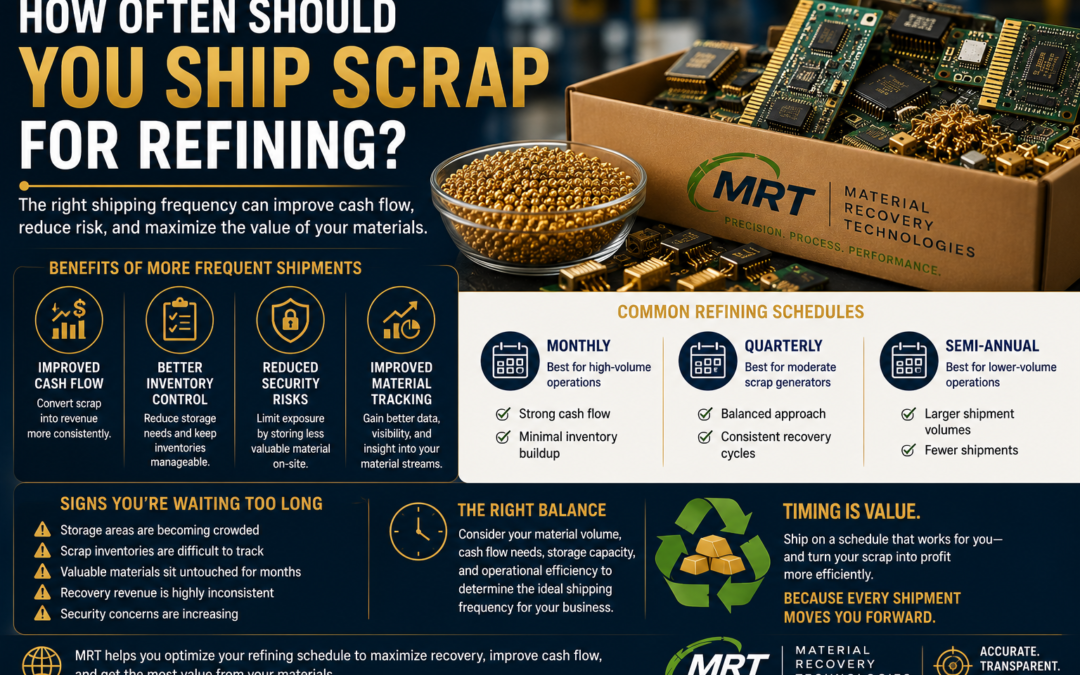
If your business generates gold-bearing electronic scrap, industrial components, or precious metal-containing materials, one question inevitably comes up:
How often should we ship material for refining?
The answer depends on your material volume, cash flow needs, storage capacity, and operational goals.
While many businesses wait until large quantities accumulate, that approach isn’t always the most profitable or efficient.
Let’s explore the factors that help determine the ideal refining schedule.
Why Refining Frequency Matters
The timing of your shipments can impact:
- Cash flow
- Inventory management
- Security risks
- Material tracking
- Recovery planning
Finding the right balance helps maximize value while maintaining operational efficiency.
The Hidden Cost of Holding Scrap
Many companies view scrap as something to store until a large shipment is ready.
However, precious metal-bearing materials often represent:
- Unrecognized inventory
- Unused capital
- Delayed revenue
Every month valuable scrap sits in storage is another month that value remains inaccessible.
Instead of generating cash, the material simply occupies space.
Benefits of More Frequent Shipments
For many businesses, smaller and more frequent refining cycles offer several advantages.
Improved Cash Flow
Regular shipments create more consistent recovery payments.
Rather than waiting several months for one large payout, businesses can convert material into revenue throughout the year.
This often improves:
- Liquidity
- Budget planning
- Operational flexibility
Better Inventory Control
Frequent shipments help reduce:
- Storage requirements
- Inventory buildup
- Material handling challenges
Managing smaller quantities is often easier than tracking large volumes accumulated over long periods.
Reduced Security Risks
Gold-bearing scrap can hold significant value.
The longer materials remain on-site, the greater the exposure to:
- Loss
- Theft
- Misplacement
- Inventory discrepancies
Regular shipments reduce the amount of valuable material being stored at any given time.
Improved Material Tracking
More frequent recovery cycles provide:
- Better reporting
- More recovery data
- Improved visibility into material streams
This makes it easier to evaluate:
- Recovery performance
- Material generation rates
- Long-term recovery trends
When Larger Shipments Make Sense
While frequent shipments offer advantages, larger shipments can also be appropriate in certain situations.
Examples include:
Low Scrap Volume
If your operation generates relatively small amounts of material, it may be more practical to accumulate enough volume before shipping.
Specialized Material Types
Certain materials may require larger lots for processing efficiency or evaluation purposes.
Transportation Considerations
Depending on logistics and shipping arrangements, larger consolidated shipments may sometimes reduce transportation costs.
Finding the Right Balance
For most businesses, the ideal schedule is somewhere between:
- Shipping too often
- Waiting too long
The goal is to balance:
Material Volume
How quickly valuable scrap accumulates.
Cash Flow Needs
How often you want to convert scrap into revenue.
Storage Capacity
How much material can be safely stored.
Operational Efficiency
How refining fits into your overall workflow.
There is no universal schedule because every operation is different.
Common Refining Schedules
Many businesses follow one of these general approaches:
Monthly
Best for:
- High-volume manufacturers
- Electronics recyclers
- Industrial operations generating consistent scrap
Benefits:
- Strong cash flow
- Minimal inventory buildup
Quarterly
Best for:
- Moderate scrap generators
- Companies balancing volume and logistics
Benefits:
- Fewer shipments
- Consistent recovery cycles
Semi-Annual
Best for:
- Lower-volume operations
- Businesses with limited scrap generation
Benefits:
- Larger shipment volumes
- Reduced shipping frequency
Signs You’re Waiting Too Long
You may be holding material too long if:
- Storage areas are becoming crowded
- Scrap inventories are difficult to track
- Valuable materials sit untouched for months
- Recovery revenue is highly inconsistent
- Security concerns are increasing
These are often indicators that a more frequent refining schedule could improve operations.
How Material Recovery Technologies Helps Businesses Optimize Recovery Cycles
At Material Recovery Technologies (MRT), refining isn’t just about recovering precious metals—it’s about helping businesses recover value efficiently.
MRT focuses on:
- Accurate material evaluation
- Yield optimization
- Transparent recovery tracking
- Flexible processing solutions
By understanding your material stream and operational needs, MRT helps determine a refining schedule that supports both recovery performance and business objectives.
Final Takeaway
There is no one-size-fits-all answer to how often you should ship scrap for refining.
The right schedule depends on:
- Material volume
- Cash flow goals
- Storage capacity
- Operational priorities
For many businesses, more frequent refining cycles can improve cash flow, reduce risk, and provide better visibility into recovery performance.
Because when it comes to precious metal recovery, timing can be just as important as the material itself.
Recent Comments