
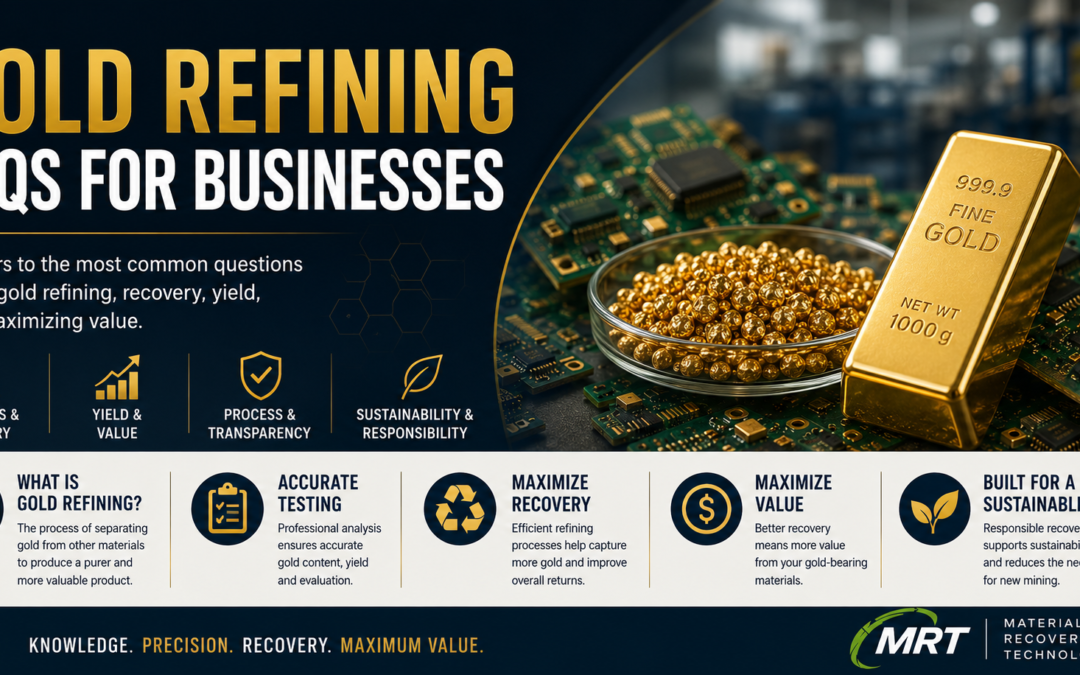
For businesses handling electronic scrap, industrial materials, or precious metal-bearing components, gold refining can feel complex.
Questions about yield, purity, processing, and payouts are common — especially for companies new to precious metal recovery.
To help simplify the process, here are answers to some of the most frequently asked questions businesses have about gold refining.
What Is Gold Refining?
Gold refining is the process of separating gold from other materials and impurities to produce a cleaner, more valuable final product.
In industrial and electronic recycling environments, refining often involves:
- Material analysis
- Separation processes
- Chemical or mechanical recovery
- Purification stages
The goal is to recover as much usable gold as possible from the original material.
What Types of Materials Contain Recoverable Gold?
Gold is commonly found in:
- Circuit boards
- Gold-plated connectors
- CPUs and integrated circuits
- Telecom equipment
- Industrial electronics
- Machinery components
Even though the gold content is often small per item, large volumes can contain significant value.
How Is Gold Measured During Refining?
Gold content is typically evaluated through material analysis and testing methods such as:
- Assaying
- Laboratory analysis
- Recovery measurement during processing
These methods help determine:
- Estimated gold content
- Recovery potential
- Final refined output
Accurate testing is critical for transparency and yield optimization.
What Is Recovery Yield?
Yield refers to the percentage of available gold successfully recovered from the material.
For example:
If a material contains 100 grams of recoverable gold and 95 grams are recovered:
- The yield is 95%
Yield is one of the most important performance indicators in gold refining because it directly impacts value recovery.
What’s the Difference Between Yield and Purity?
These terms are often confused.
Yield
How much gold was successfully recovered.
Purity
How refined or clean the recovered gold is.
You can have:
- High purity but low yield
- High yield but lower purity
Strong refining systems aim to optimize both.
How Long Does Gold Refining Take?
Processing time depends on several factors, including:
- Material type
- Volume of material
- Complexity of recovery
- Testing requirements
Some materials process relatively quickly, while more complex industrial materials may require additional preparation and recovery stages.
Why Is Material Sorting Important?
Proper sorting improves:
- Recovery efficiency
- Testing accuracy
- Recovery yield
- Overall value
Mixing low-value materials with high-value scrap can dilute recovery performance and reduce profitability.
Separating materials before processing helps maximize results.
Can Small Amounts of Scrap Still Be Valuable?
Yes.
Gold in electronics is often distributed in very small amounts across:
- Connectors
- Chips
- Bonding wires
- Circuit traces
While a single component may contain minimal gold, accumulated material across larger volumes can become highly valuable.
What Affects the Value of Gold-Bearing Scrap?
Several factors influence value, including:
- Gold concentration
- Material type
- Recovery yield
- Purity of recovered gold
- Current market conditions
The efficiency of the refining process also plays a major role in the final outcome.
Why Does Recovery Efficiency Matter So Much?
Even small losses during refining can significantly impact value.
Efficient refining systems help:
- Capture fine gold particles
- Reduce processing losses
- Improve overall recovery performance
In precious metal recovery, small percentage improvements in yield can produce meaningful financial gains.
Is Gold Refining Environmentally Friendly?
Modern refining and recovery systems can support sustainability goals by:
- Reducing landfill waste
- Recovering reusable metals
- Lowering dependence on new mining
- Supporting circular material use
Responsible recovery systems help businesses reduce environmental impact while recovering valuable resources.
How Material Recovery Technologies Supports Businesses
At Material Recovery Technologies (MRT), gold refining is approached with a focus on:
- Accurate material evaluation
- Yield optimization
- Transparent recovery tracking
- Efficient processing systems
The goal is to help businesses maximize recovery value while maintaining clarity and confidence throughout the process.
Final Takeaway
Gold refining doesn’t have to be confusing.
Understanding key concepts like:
- Yield
- Purity
- Material sorting
- Recovery efficiency
- Testing accuracy
helps businesses make smarter decisions about their materials and recovery strategies.
Because in precious metal recovery, knowledge is part of the value recovery process itself.
Recent Comments