
When people think about gold recovery, they often picture large, visible pieces of metal.
But in modern electronics, gold is rarely seen — and almost never in large amounts.
Instead, it exists in thin layers, microscopic coatings, and highly engineered components inside circuit boards.
So what actually gets recovered?
Let’s break it down.
Where Gold Exists in Circuit Boards
Gold is used in electronics because it is:
- Highly conductive
- Resistant to corrosion
- Extremely reliable for signal transmission
Because of these properties, gold is strategically placed in critical areas of a circuit board.
Common Gold-Bearing Components
You’ll typically find gold in:
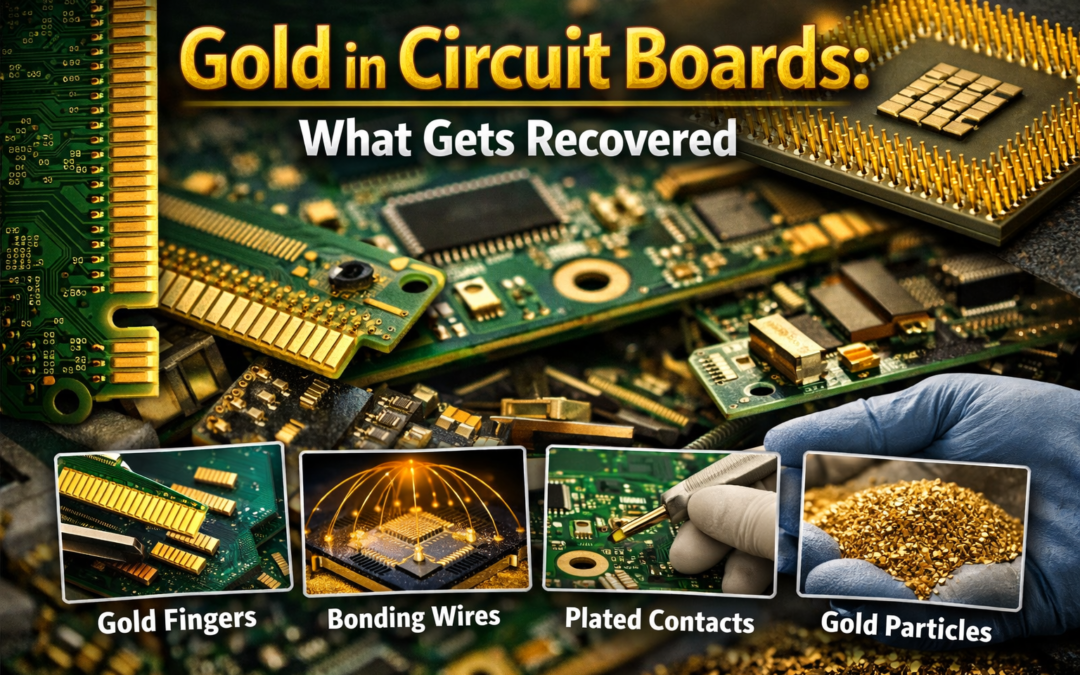
- Edge connectors (“gold fingers”)
- Pin connectors and contacts
- Integrated circuit (IC) bonding wires
- Plated contact points
- CPU and chip interfaces
These areas require precision and durability — which is why gold is used.
How Much Gold Is Actually There?
This is where expectations often differ from reality.
Circuit boards contain small amounts of gold spread across many components.
For example:
- Gold plating may be only microns thick
- Tiny bonding wires inside chips contain trace amounts
- Connectors may have higher concentrations, but still in thin layers
Individually, these amounts seem small — but across large volumes, they become valuable.
What Gets Recovered During Processing
During a proper recovery process, the goal is to extract all recoverable gold from the material stream.
This typically includes:
1. Gold Plating
Thin layers of gold on connectors and contacts are dissolved and recovered.
2. Bonding Wires
Inside integrated circuits, extremely fine gold wires are recovered during processing.
3. Surface Deposits
Any exposed gold on board surfaces or connection points is targeted.
4. Residual Particles
Microscopic gold particles released during shredding and processing are also captured.
The key is ensuring that these small, distributed sources are not lost during recovery.
What Does Not Get Recovered as Gold
Not everything in a circuit board is gold — and not all materials are recovered as gold.
Other materials include:
- Copper
- Aluminum
- Tin
- Nickel
- Plastics and resins
- Ceramics
Some of these metals may be recoverable separately, but they are not part of gold recovery itself.
Understanding this helps set realistic expectations about yield and value.
Why Recovery Efficiency Matters
Because gold in circuit boards is so finely distributed, recovery efficiency is critical.
If even a small percentage is lost during processing, it can significantly impact total value.
Key factors that affect recovery include:
- Quality of material preparation
- Precision of chemical or mechanical processes
- Accuracy of initial material analysis
- Effectiveness of particle capture systems
In this environment, small losses add up quickly.
The Role of Yield in Circuit Board Recovery
Yield becomes especially important when dealing with electronic scrap.
Since gold is present in small quantities across many components:
Yield determines how much of that distributed gold is actually captured.
A high-yield process ensures that:
- Fine particles are not lost
- Dissolved gold is fully recovered
- All gold-bearing components are properly processed
Without strong yield control, valuable material can be left behind.
How Material Recovery Technologies Approaches Circuit Board Recovery
At Material Recovery Technologies (MRT), circuit board recovery is approached as a precision process.
MRT focuses on:
- Accurate material evaluation
- Controlled processing systems
- Recovery optimization
- Transparent performance tracking
The objective is to recover as much gold as possible from every component — no matter how small.
Because in electronic scrap, value is not concentrated in one place.
It’s distributed — and must be captured that way.
Final Takeaway
Gold in circuit boards is not obvious — but it is valuable.
It exists in thin layers, tiny wires, and microscopic deposits spread across complex materials.
What gets recovered depends on:
- How well the material is prepared
- How precise the recovery process is
- How effectively yield is managed
Understanding where gold exists — and how it’s recovered — helps businesses better evaluate the true value of their electronic materials.
Because in modern recovery, the smallest details often hold the greatest value.
Recent Comments