
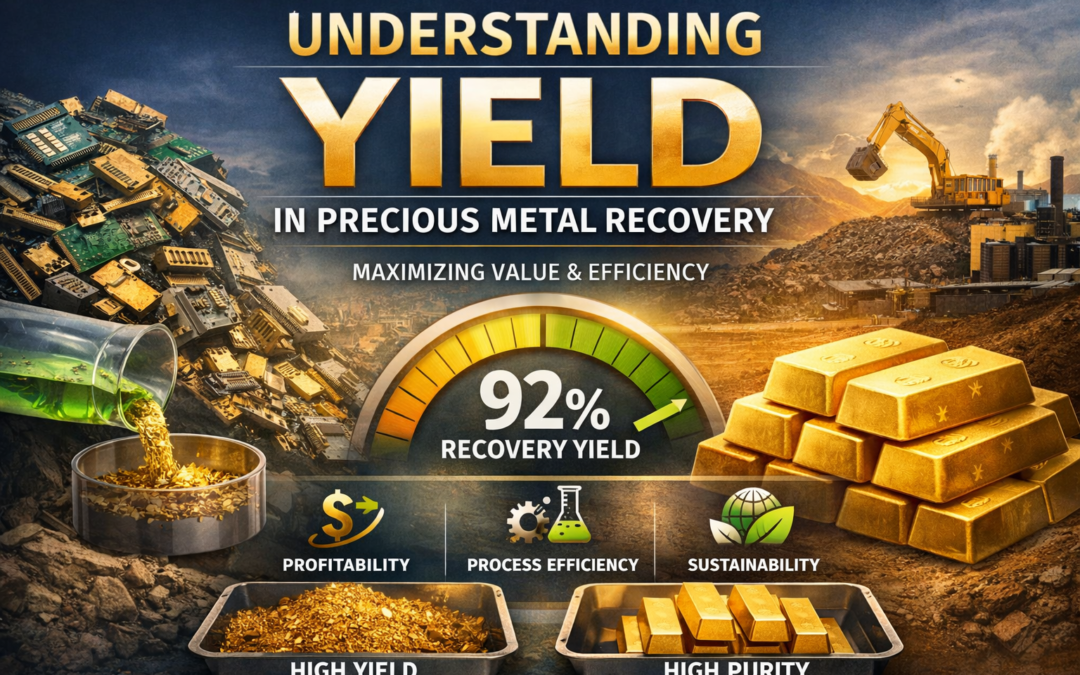
When people hear the word yield, they often think it simply means “how much gold you get.”
In precious metal recovery, yield is much more precise — and much more important.
For companies recycling electronics, refining scrap, or processing high-value materials, yield directly impacts profit, efficiency, and long-term sustainability.
Let’s break it down clearly.
What Is Yield in Precious Metal Recovery?
In precious metal recovery, yield is the percentage of recoverable metal successfully extracted from a given material stream.
If 1,000 grams of scrap material contains 100 grams of recoverable gold and 92 grams are successfully recovered, the yield is:
92% recovery yield
Yield measures efficiency, not just output.
It answers the real question:
How much of the available metal did we actually capture?
Why Yield Matters So Much
Even small improvements in yield can mean major financial gains.
1. Profitability
In gold recovery, every percentage point matters.
If a processor handles millions of dollars in material annually, improving yield from 90% to 95% can translate into substantial revenue increases — without increasing material volume.
2. Process Efficiency
Higher yield means:
- Better separation methods
- More accurate assays
- Reduced material loss
- Improved chemical or mechanical optimization
3. Sustainability
Recovering more precious metal from the same material stream reduces:
- Mining demand
- Waste generation
- Environmental impact
Efficient recovery supports both economic and environmental goals.
Yield vs. Purity: They’re Not the Same
This is where confusion often happens.
- Yield = How much of the available metal was recovered
- Purity = How refined or clean that recovered metal is
You can have:
- High purity but low yield (very clean metal, but you lost a lot in processing)
- High yield but poor purity (you captured a lot, but it needs further refining)
True optimization requires both.
What Affects Yield in Gold Recovery?
Yield depends on multiple variables:
Material Type
- Printed circuit boards
- Gold-plated connectors
- Integrated circuits
- Industrial scrap
Each has different gold distribution patterns.
Pre-Processing
Proper shredding, separation, and classification dramatically influence recovery rates.
Assay Accuracy
You can’t improve what you don’t measure correctly. Accurate material evaluation is critical.
Recovery Method
Chemical, thermal, or mechanical recovery methods must be calibrated precisely to minimize losses.
What a 5–15% Yield Improvement Really Means
In industrial recovery environments, a 5–15% improvement in yield is not incremental — it’s transformational.
For example:
If a facility processes $10 million worth of gold-bearing material annually:
- A 5% improvement could mean hundreds of thousands of dollars in additional recovered value.
- A 10–15% improvement can fundamentally change operating margins.
That’s why yield optimization is a strategic priority, not just a technical adjustment.
How Material Recovery Technologies Approaches Yield
At Material Recovery Technologies (MRT), yield isn’t treated as a single number — it’s treated as a controlled system.
MRT focuses on:
- Advanced material evaluation
- Precision separation techniques
- Process optimization
- Data-driven performance tracking
The goal is simple:
Recover the maximum amount of gold possible from every batch — consistently and transparently.
Because in precious metal recovery, yield isn’t just a metric.
It’s the difference between average results and maximum value.
Final Takeaway
When evaluating a recovery partner, don’t just ask:
- “How much gold did we get?”
Ask:
- “What was the recovery yield?”
- “How much of the available metal was actually captured?”
- “How do you measure and improve yield over time?”
Understanding yield gives you clarity, accountability, and control over your precious metal recovery strategy.
And in this industry, precision equals profit.
Recent Comments