
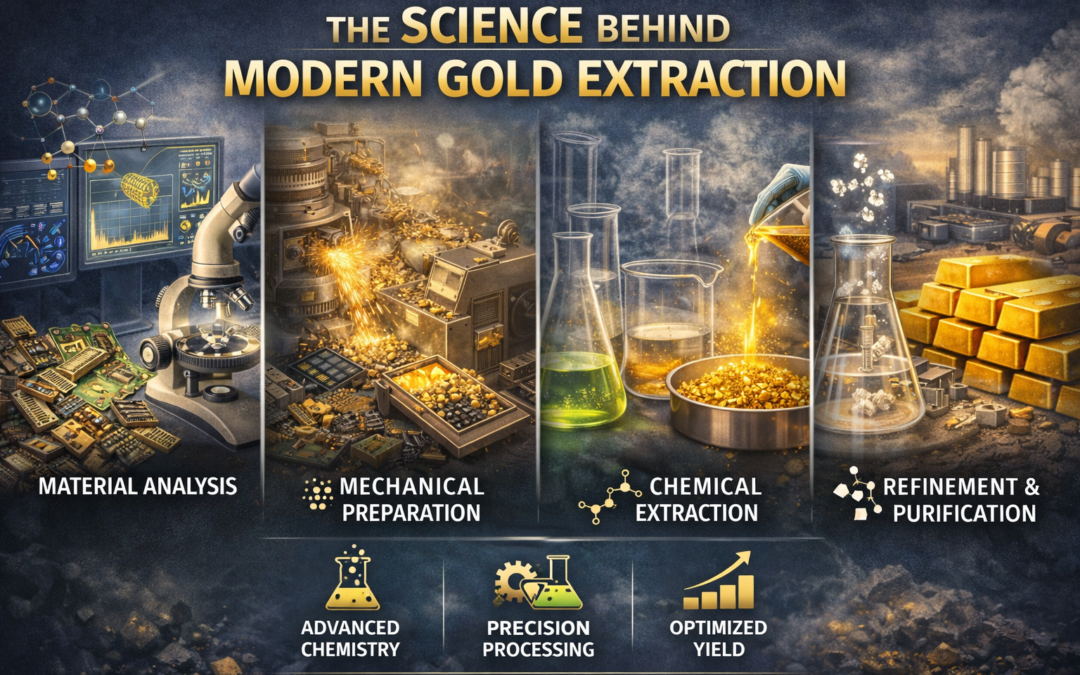
Gold has been valued for thousands of years, but the way it is extracted has evolved dramatically.
Today’s gold recovery methods rely on advanced chemistry, material science, and precision engineering to recover precious metals from complex materials such as electronic scrap, industrial components, and mixed metal streams.
Modern gold extraction is no longer just about mining ore from the ground. It’s about efficiently recovering valuable metals from the materials already in circulation.
Let’s explore the science that makes modern gold extraction possible.
Where Gold Exists in Modern Materials
Gold is used in many industries because of its unique properties:
- Excellent electrical conductivity
- High corrosion resistance
- Exceptional durability
- Reliable signal transmission
For this reason, gold is commonly found in:
- Printed circuit boards
- Connectors and contacts
- Integrated circuits
- Aerospace electronics
- Telecommunications equipment
Even though the amount of gold in each component may be small, large volumes of material contain significant recoverable value.
Why Gold Must Be Extracted Precisely
Gold in modern materials is rarely present as large pieces.
Instead, it typically exists as:
- Thin plating layers
- Microscopic particles
- Alloyed components mixed with other metals
This means extraction requires highly controlled processes that separate gold from copper, nickel, silver, plastics, ceramics, and other materials.
The science behind modern recovery focuses on selectivity and efficiency.
The Role of Material Analysis
Before recovery begins, the material must be analyzed.
This process, often called assaying, determines:
- How much gold is present
- What other metals are present
- How the materials are structured
Accurate analysis helps determine the best recovery method and prevents value loss.
Without precise material analysis, recovery systems cannot operate efficiently.
Mechanical Pre-Processing
Before chemical recovery can occur, materials are often prepared through mechanical processes.
These may include:
- Shredding or size reduction
- Magnetic separation
- Density separation
- Removal of non-metallic components
This step concentrates the gold-bearing materials and prepares them for the extraction stage.
Proper pre-processing significantly improves recovery efficiency.
Chemical Extraction: Dissolving Gold
One of the most important scientific principles used in gold recovery is selective dissolution.
Certain chemical solutions can dissolve gold while leaving many other materials untouched.
During this stage:
- Gold transitions from solid metal into a dissolved ionic state
- Chemical reactions isolate the gold within a controlled solution
- Process conditions such as temperature, pH, and concentration are carefully monitored
This controlled chemical environment allows gold to be separated from complex material streams.
Recovery Through Chemical Reduction
Once gold has been dissolved into solution, it must be converted back into solid metal.
This is done through reduction reactions or precipitation processes.
During this stage:
- Chemical agents cause gold ions to revert to metallic form
- Gold particles form and settle out of solution
- The recovered material is collected and processed further
This step transforms dissolved gold into a recoverable solid product.
Refinement and Purification
After recovery, the gold may undergo additional refining processes to improve purity.
These steps can include:
- Washing and filtration
- Additional chemical treatment
- Controlled purification stages
The goal is to achieve both high recovery yield and high metal purity.
In modern recovery systems, these two metrics are carefully monitored and optimized.
Technology and Data in Modern Recovery
Modern gold extraction increasingly relies on data-driven process control.
Advanced recovery systems use:
- Process monitoring sensors
- Chemical concentration tracking
- Yield analysis
- Performance data from each recovery stage
This allows operators to continuously improve recovery efficiency and reduce metal losses.
Why Modern Gold Recovery Matters
Recovering gold from existing materials provides major benefits.
Resource Efficiency
Precious metals already in circulation can be reused rather than mined again.
Environmental Benefits
Recovery reduces the environmental impact associated with traditional mining.
Economic Value
Efficient extraction systems capture more value from complex materials.
Modern recovery systems transform what might otherwise be waste into valuable resources.
How Material Recovery Technologies Approaches Gold Extraction
At Material Recovery Technologies (MRT), gold recovery is approached through a combination of science, engineering, and process control.
MRT focuses on:
- Accurate material evaluation
- Precision recovery systems
- Yield optimization
- Transparent recovery measurement
The goal is simple: recover the maximum possible value from every material stream.
Final Takeaway
Modern gold extraction is built on chemistry, engineering, and precision.
From material analysis to chemical recovery and final refinement, every stage relies on scientific principles designed to isolate and recover precious metals efficiently.
Understanding the science behind these systems helps businesses make better decisions about how their materials are processed and how much value is truly being recovered.
Because in modern precious metal recovery, science drives efficiency — and efficiency drives value.
Recent Comments