
When it comes to precious metal recovery, one of the most important — and often misunderstood — topics is testing accuracy.
If you’re sending gold-bearing materials for processing, the way those materials are tested directly impacts:
- How much value is identified
- How much value is recovered
- How much you ultimately get paid
Two common approaches are lab testing and smelter-based evaluation.
While both aim to determine metal content, they operate very differently — and those differences matter.
What Is Lab Testing?
Lab testing (also called analytical or assay testing) involves evaluating a sample of material in a controlled environment before full processing.
This typically includes:
- Sampling a portion of the material
- Preparing and homogenizing the sample
- Using analytical techniques to determine metal content
The goal is to estimate how much gold (and other metals) is present before recovery begins.
What Is Smelter Testing?
Smelter testing evaluates material during or after high-temperature processing.
Instead of analyzing a sample beforehand, smelters:
- Melt the material at high temperatures
- Combine metals into a molten mixture
- Recover and measure metals after processing
In this model, the final recovered metal often determines the reported value.
The Key Difference: Sample vs. Outcome
The biggest difference between lab testing and smelter testing comes down to this:
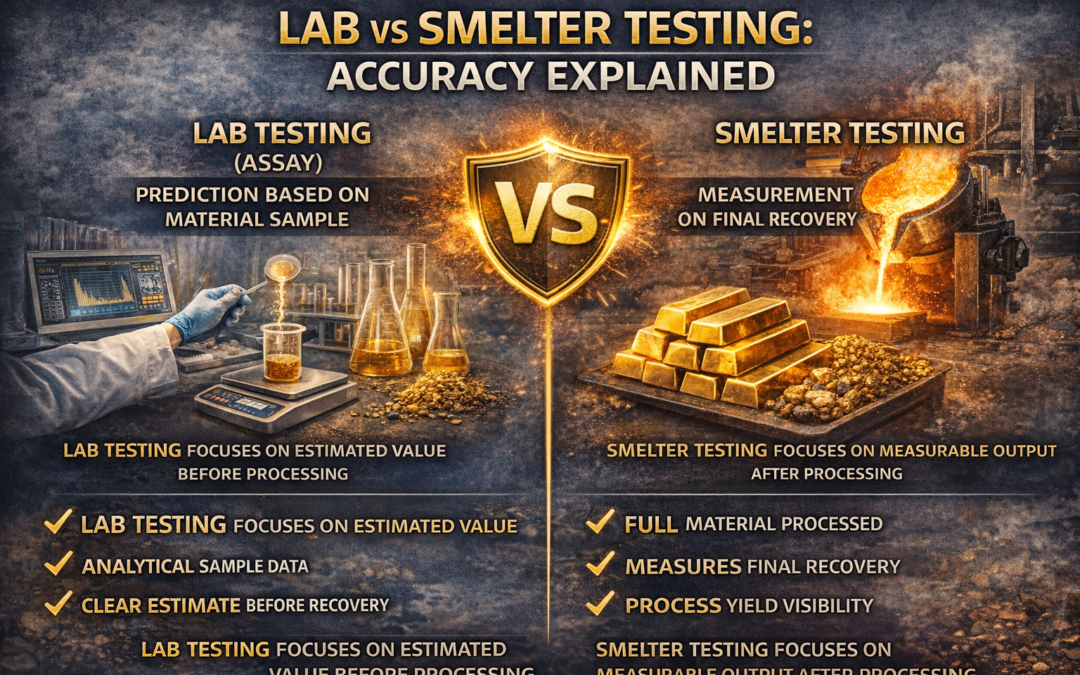
- Lab testing = prediction based on a sample
- Smelter testing = measurement based on final recovery
Both approaches provide useful information — but they serve different purposes.
Where Accuracy Can Be Affected
In Lab Testing
Accuracy depends on how well the sample represents the entire material batch.
Challenges can include:
- Uneven material composition
- Improper sampling techniques
- Incomplete homogenization
If the sample is not representative, the results may not reflect the true value of the full lot.
In Smelter Testing
Accuracy depends on recovery efficiency during processing.
Challenges can include:
- Metal losses during melting
- Mixing of multiple materials
- Limited visibility into process losses
Because evaluation happens after processing, it may be harder to separate material value from process performance.
Transparency and Visibility
One of the biggest practical differences is how much visibility you have into the process.
Lab Testing Visibility
- Provides a clear estimate of material content upfront
- Allows comparison before processing
- Helps identify expected recovery value
Smelter Testing Visibility
- Focuses on final output
- May not show how much was lost during processing
- Can make it harder to track yield efficiency
Understanding both perspectives is important for evaluating results.
Why Both Methods Matter
Lab testing and smelter testing are not necessarily competing methods — they are often used together.
- Lab testing helps estimate potential value
- Smelter results show actual recovered value
When both are aligned, they provide a clearer picture of:
- Recovery yield
- Process efficiency
- Overall performance
The most accurate understanding comes from comparing what should be recovered vs. what was actually recovered.
The Role of Yield in Accuracy
Accuracy is not just about measurement — it’s also about recovery performance.
Even with perfect lab testing:
- If recovery processes are inefficient, value can be lost
And even with strong smelter results:
- Without baseline testing, it’s hard to know if more could have been recovered
That’s why yield plays a critical role in interpreting both testing methods.
How Material Recovery Technologies Approaches Testing
At Material Recovery Technologies (MRT), testing is approached as part of a complete system — not a single step.
MRT focuses on:
- Accurate material evaluation
- Controlled recovery processes
- Transparent performance tracking
- Yield optimization
By combining analytical insight with process control, MRT helps ensure that testing reflects both true material value and actual recovery performance.
Final Takeaway
Lab testing and smelter testing each provide valuable information — but they answer different questions.
- Lab testing asks: What should be there?
- Smelter testing asks: What was actually recovered?
Understanding both helps businesses make better decisions about their materials, recovery partners, and overall performance.
Because in precious metal recovery, accuracy isn’t just about measurement — it’s about knowing how much value was truly captured.
Recent Comments