
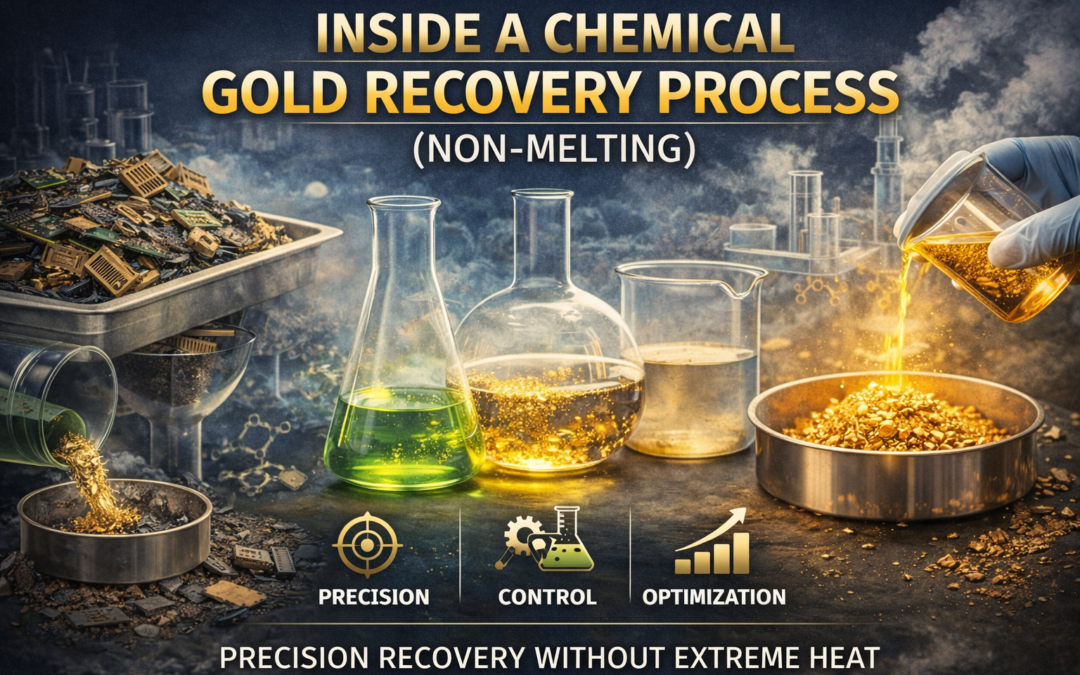
When most people picture gold recovery, they imagine furnaces, molten metal, and dramatic pours.
But in many modern recovery environments — especially when processing electronic scrap — gold is not melted first.
Instead, it is selectively separated using controlled chemical processes designed to dissolve, isolate, and recover precious metals with precision.
Let’s walk through how a non-melting chemical gold recovery process works — and why it matters.
Why Use a Chemical (Non-Melting) Process?
Traditional smelting uses extreme heat to separate metals. While effective in some scenarios, it can:
- Consume large amounts of energy
- Mix multiple metals together
- Require additional downstream refining
- Produce emissions that must be managed
A chemical recovery process takes a different approach:
Instead of melting everything together, it selectively dissolves and isolates gold from the start.
This allows for greater control, improved recovery yield, and cleaner separation.
Step 1: Material Preparation
Before any chemistry begins, the incoming material must be prepared properly.
Common gold-bearing materials include:
- Printed circuit boards
- Gold-plated connectors
- Integrated circuits
- Industrial electronic scrap
Preparation typically involves:
- Shredding or size reduction
- Mechanical separation of non-metallic components
- Removal of base materials that are not gold-bearing
Proper pre-processing directly impacts recovery efficiency.
Step 2: Selective Dissolution
This is where chemistry becomes powerful.
Specific chemical solutions are introduced that:
- React with gold
- Dissolve it into solution
- Leave many other materials unaffected
The goal is not to dissolve everything — only the target precious metal.
At this stage, gold transitions from a solid metal into a dissolved ionic form within a controlled solution.
Precision in temperature, concentration, and timing is critical.
Step 3: Solution Filtration and Clarification
Once the gold is dissolved:
- Solid residues are filtered out
- Impurities are separated
- The gold-rich solution is clarified
This step ensures that when recovery begins, the system is working with a clean, controlled environment.
Accurate monitoring here protects overall yield.
Step 4: Gold Recovery from Solution
After gold is fully dissolved and isolated in solution, it must be brought back out of solution in metallic form.
This is typically done through:
- Chemical precipitation
- Reduction reactions
- Controlled deposition methods
Gold particles form and are collected.
Unlike smelting, this recovery happens at controlled temperatures — not extreme heat.
The result is recovered gold material ready for final refining or purification steps.
Step 5: Refinement & Purity Control
After recovery, the gold may undergo:
- Washing
- Drying
- Additional refining for purity enhancement
At this stage, both yield and purity are evaluated:
- Yield = How much of the available gold was recovered
- Purity = How refined the final metal product is
Both must be optimized for maximum value.
Advantages of Non-Melting Chemical Recovery
When properly engineered and monitored, chemical recovery offers several benefits:
Higher Precision
Selective dissolution targets gold directly rather than melting mixed metals.
Improved Yield Control
Processes can be measured and optimized at each stage.
Lower Energy Requirements
No need for high-temperature furnaces during primary extraction.
Scalable Systems
Chemical processes can be scaled and adjusted depending on material type.
Where Yield Can Be Lost
Even in chemical systems, losses can occur if:
- Assays are inaccurate
- Material preparation is incomplete
- Chemical concentrations are inconsistent
- Reaction timing is poorly controlled
That’s why process monitoring and data tracking are essential in professional recovery environments.
How Material Recovery Technologies Approaches Chemical Recovery
At Material Recovery Technologies (MRT), chemical gold recovery is not treated as a simple “dissolve and collect” operation.
It is managed as a controlled, measurable system designed to:
- Maximize recovery yield
- Maintain process stability
- Ensure transparent evaluation
- Minimize material loss
Every step — from intake to final recovery — is optimized to capture the maximum available value from electronic and industrial scrap.
Final Takeaway
Gold recovery does not always require melting.
In fact, in many advanced recovery environments, chemical processes offer:
- Greater precision
- Improved control
- Better yield optimization
- Reduced energy consumption
Understanding how non-melting chemical recovery works helps businesses make smarter decisions about how their precious metals are processed.
Because in precious metal recovery, control equals value — and precision drives profit.
If you want to better understand how your gold-bearing materials are being processed, visit mrtgold.com to learn more about advanced recovery systems.
Recent Comments