
If your company generates electronic scrap, circuit boards, connectors, or gold-plated components, you’re sitting on hidden value.
The key question is simple:
What is your real return on investment (ROI) from recovering scrap gold?
This guide explains exactly how to calculate ROI on scrap gold so you can make smarter financial decisions.
What Is Scrap Gold ROI?
ROI (Return on Investment) measures how much profit you make compared to what it costs you to recover the gold.
Basic ROI Formula:ROI=Total CostNet Profit×100
In gold recovery terms:ROI=Recovery Costs(Recovered Gold Value−Recovery Costs)×100
Step 1: Determine the Gold Content
4
First, you need to estimate how much recoverable gold exists in your scrap.
This depends on:
- Type of electronics (CPUs, RAM, connectors, telecom boards)
- Thickness of gold plating
- Overall material grade
- Purity percentage
Material Recovery Technologies uses advanced material characterization to determine:
- Total recoverable gold (in grams or kilograms)
- Expected recovery efficiency
- Loss percentages
Example:
- 1,000 kg of high-grade circuit boards
- Estimated gold content: 2 kg
- Expected recovery rate: 95%
- Recoverable gold: 1.9 kg
Step 2: Calculate Market Value
Multiply recovered gold weight by current market price.
Example:
- 1.9 kg recovered
- Gold price: $60,000 per kg
1.9×60,000=114,000
Gross recovered gold value = $114,000
Step 3: Add Up All Recovery Costs
4
Your total cost includes:
- Processing and refining fees
- Chemical and reagent costs
- Labor
- Transportation
- Compliance and environmental handling
- Energy consumption
Example:
- Processing cost: $35,000
- Transport & logistics: $5,000
- Environmental & compliance: $4,000
Total cost = $44,000
Step 4: Calculate Net Profit
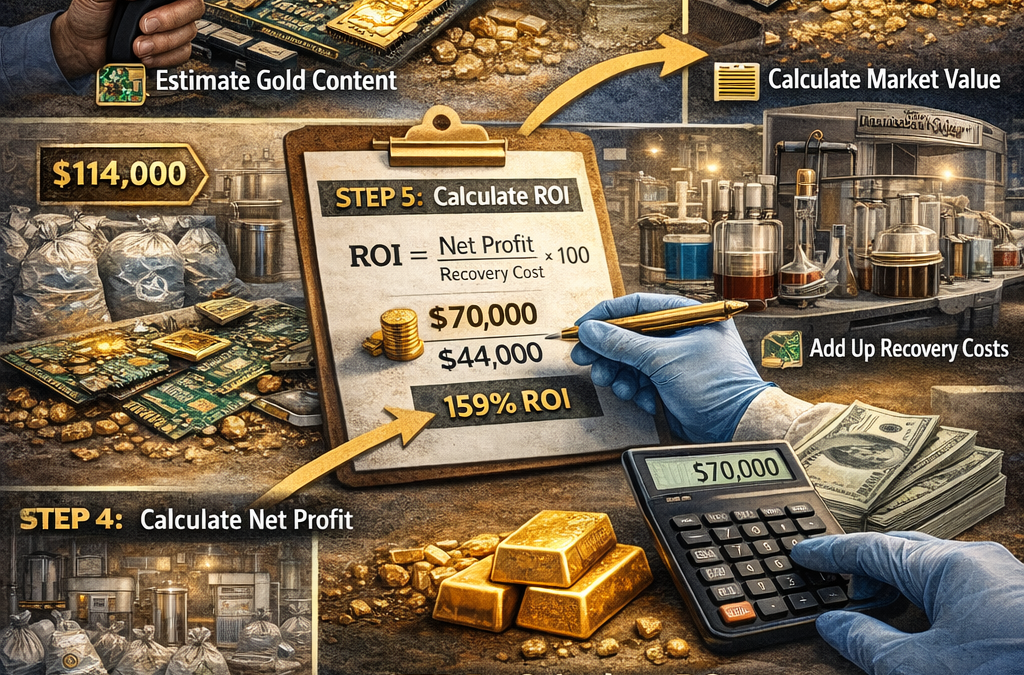
114,000−44,000=70,000
Net profit = $70,000
Step 5: Calculate ROI
ROI=44,00070,000×100 ROI=159%
ROI = 159% return on investment
That means for every $1 spent on recovery, you earned $1.59 in profit.
Why ROI Varies in Scrap Gold Recovery
ROI depends on:
- Feedstock quality
- Recovery efficiency
- Gold market pricing
- Process optimization
- Fine particle capture
- Chemical control precision
Companies that improve recovery yield by 5–15% often see ROI increase dramatically without increasing volume.
Hidden Factors That Impact ROI
1. Gold Left in Tailings
If fine particles are lost during filtration, your ROI drops.
2. Overpaying for Processing
Not all refiners operate at the same efficiency level.
3. Poor Material Segmentation
Mixing high- and low-grade materials reduces total yield.
4. Gold Price Volatility
Timing your recovery relative to market conditions affects revenue.
Sample ROI Comparison
| Scenario | Recovery Rate | Net Profit | ROI |
|---|---|---|---|
| Standard Process | 85% | $52,000 | 118% |
| Optimized Process | 95% | $70,000 | 159% |
Even a 10% recovery improvement significantly increases ROI.
Why Partner With Material Recovery Technologies?
Material Recovery Technologies focuses on:
- Precision material analysis
- High-efficiency chemical recovery
- Fine particle capture systems
- Data-driven yield optimization
- Transparent reporting
The goal isn’t just gold recovery.
It’s maximizing your return per batch.
Key Takeaway
To calculate ROI on scrap gold:
- Determine total recoverable gold
- Multiply by market price
- Subtract all recovery costs
- Divide net profit by total cost
- Multiply by 100
Scrap gold isn’t waste.
It’s a revenue stream — if calculated correctly.
Recent Comments